Understanding Foreign Bank Account Reporting
Friday, November 6th, 2026
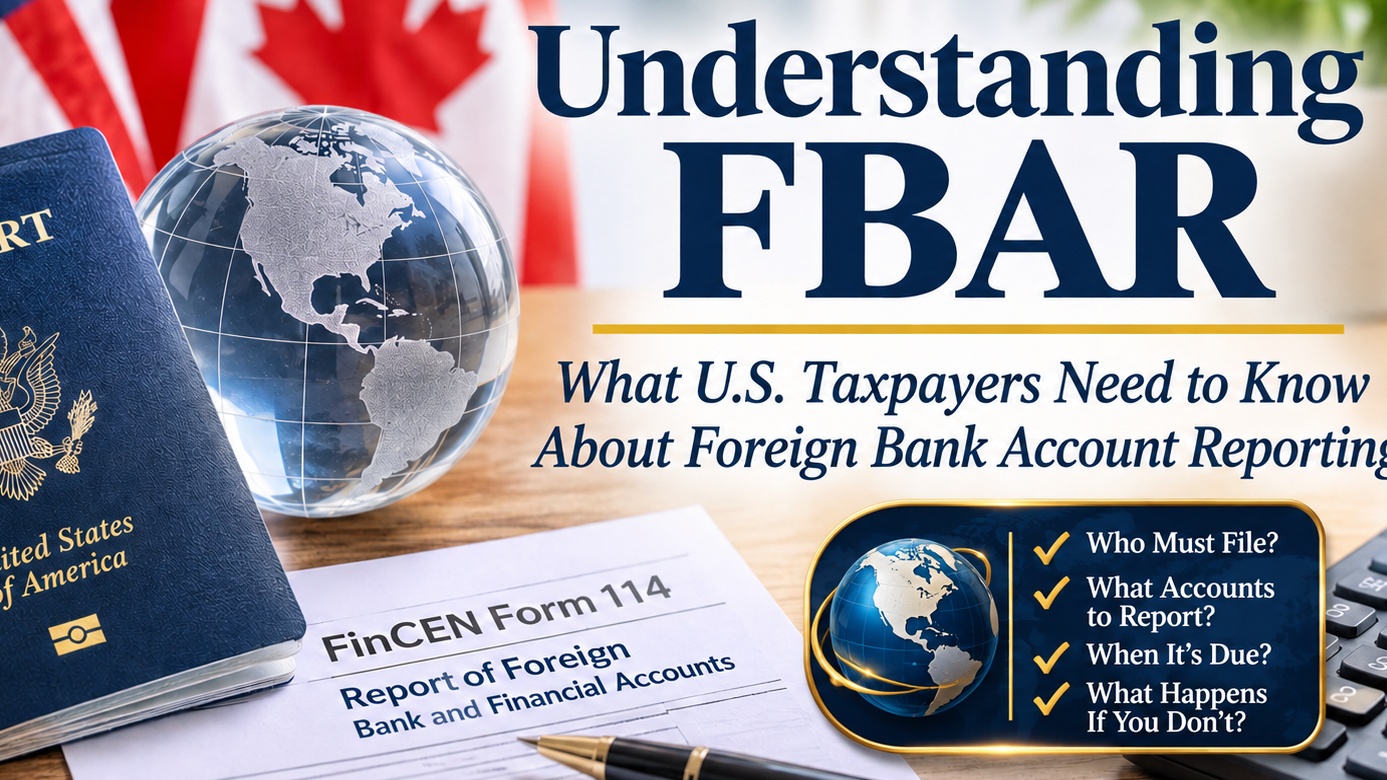
If you are a U.S. Taxpayer who owns or has access to financial accounts outside the United States, you may have additional reporting requirement that is known as Foreign Bank Account Reporting (FBAR).
Although a requirement for some, many taxpayers are unaware that holding money in a foreign bank account, maintaining a foreign investment account, or having signing authority over a overseas account can trigger additional reporting.
Understanding FBAR requirements is significant because failing to report foreign financial accounts can result in significant penalties.
What is FBAR?
FBAR is administered by the Financial Crimes Enforcement Network (FinCEN), a bureau of the U.S. Department of Treasury.
The purpose of FBAR is to help the U.S. government identify financial account held outside the Unites States by certain U.S. taxpayers.
Who is Required to File FBAR?
A U.S. person must file an FBAR if:
- The U.S. person has a financial interest, signature, or authority in at least one foreign financial account
- The combined value of all qualifying foreign financial accounts exceeds $10,000 at any point during the calendar year.
Who must report?
- U.S. Citizens
- U.S. Residents
- Certain U.S. Corporations, partnerships, and LLCs
- Certain trusts and estates
What Types of Accounts Must Be Reported
Foreign financial accounts include:
- Foreign checking and savings account
- Foreign brokerage and investment accounts
- Certain foreign mutual fund accounts
- Foreign accounts of which the individual has signing authority
- Certain Canadian financial accounts, including RRSPs, cash surrender value of life insurances, company pension accounts and TFSAs
When Is FBAR due?
FBAR is filed annually & an automatic extension is applied without requiring a separate extension request. Below are the FBAR filing dates.
2025 Reporting Year Due Date: April 15, 2026 (Extension Date October 15, 2026)
2026 Reporting Year Due Date: April 15, 2027 (Extension Date October 15, 2027)
What Happens If You Fail to File?
Failure to file FBAR when required can result in civil penalties and in certain circumstances, criminal penalties. The may need to prove the non-filing was not willfill.
Taxpayers who discover they have missed required FBAR filings should consider addressing the issue promptly. The IRS offers procedures for certain taxpayers to correct delinquent or previously unreported foreign account filings. The appropriate procedure depends on the taxpayer's individual circumstances.
Conclusion
Foreign financial accounts can create an additional reporting responsibility for U.S. corporate, LLC, partnership, trust, estates and individual taxpayers with financial connections (ownership or signing authority) to other countries.
Understanding FBAR requirements, keeping accurate financial records, and meeting the annual filing deadlines can help taxpayers avoid compilations and potential penalties.
If you maintain foreign bank accounts, investment accounts, or other overseas financial accounts, it is important to determine whether you have an FBAR filing obligation.
The above information is of a general nature only and should not be relied upon for specific situations.
Call Marlies Y Hendricks CPA PLLC at either 716-694-3500 or 910-769-8730 as required to set up an appointment for accounting, tax or cross-border CPA tax advice as a Certified Public Accountant.